

When a business needs to grow, paid advertising is often the most direct option.
Raise the budget, widen the audience, test different creatives, optimize the conversion funnel. As long as ads keep bringing in orders, there’s reason to keep investing in this approach.
But more and more businesses are facing another reality: traffic isn’t always available at the same cost. As competition intensifies and acquisition costs rise, the ad strategies that used to work may no longer deliver the returns the business needs.
And so a question gradually emerges:
If every increase in sales has to be sustained by the next round of ad spend, how long can that growth really last?
This isn’t to say performance advertising doesn’t matter. For businesses that need to acquire customers and close sales, it remains an important marketing tool.
What really needs rethinking is this: has the business pinned too much of its hope for growth on performance ads, while neglecting to build the brand itself?
To answer that, we first need to understand what brand advertising and performance advertising each set out to solve, and how brand building helps a business build more lasting competitiveness.

01 · Growth doesn’t only come from “getting consumers to buy now”
Imagine a coffee brand that wants to increase sales over the next year.
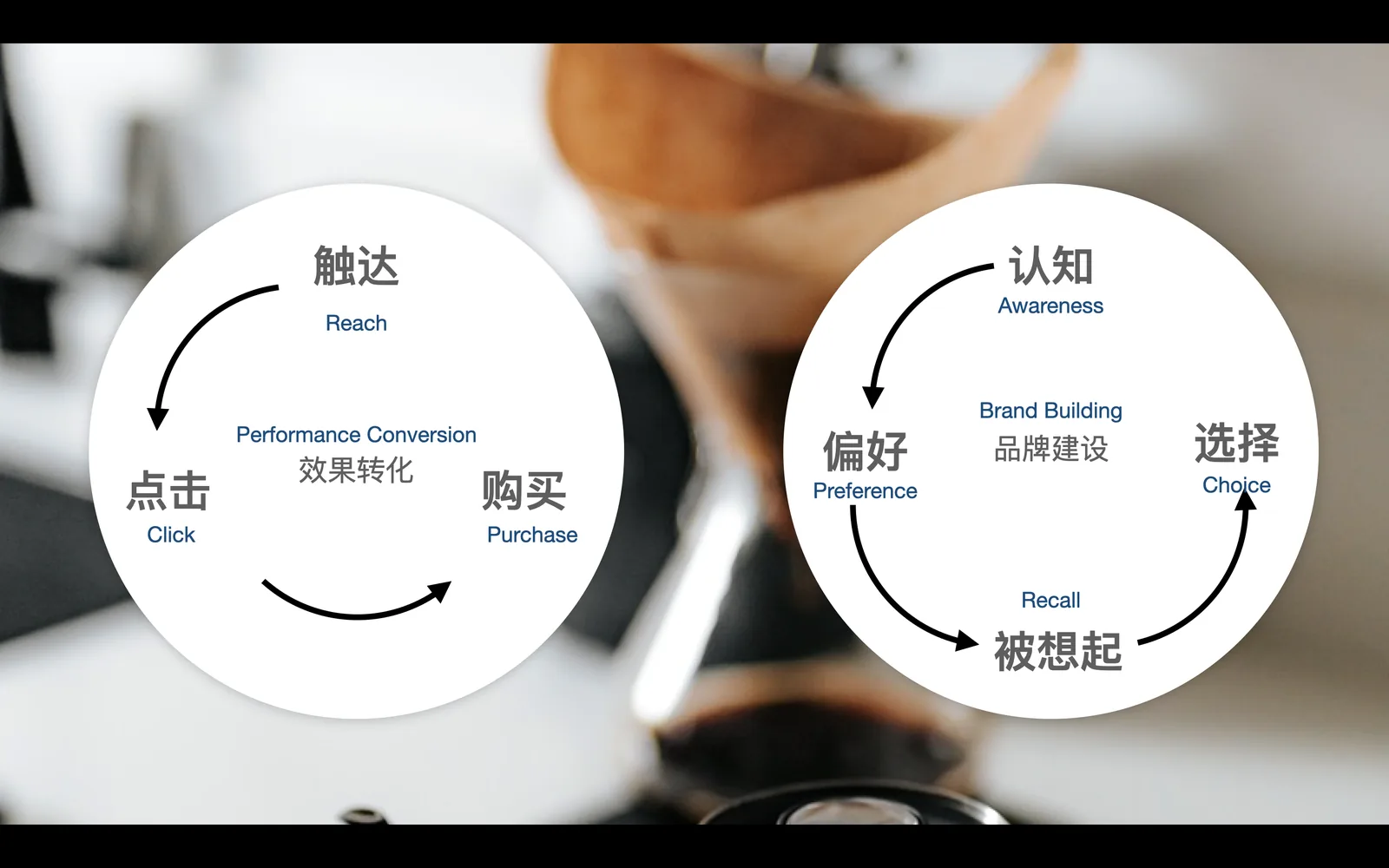
It could take a very direct route: run ads to people likely to buy coffee and use coupons, new-product recommendations and purchase links to get them to place an order.
That’s a classic performance-conversion mindset.
But the business can also do something else: get more consumers to know the brand, understand what makes its products distinctive, and develop goodwill and preference for it.
For example, letting consumers know what kind of coffee experience the brand focuses on, why it’s worth trying, and how it differs from other coffee brands.
That’s the direction brand building is concerned with.
Both look like marketing, but they carry different jobs.
Performance advertising focuses on how to make the sale happen. Brand building focuses on why consumers would consider, choose and keep remembering a brand.
The former helps a business capture demand that already exists; the latter can widen the brand’s pool of potential customers and shape consumers’ future choices.
Of course, the line isn’t absolute. Brand ads can drive sales directly, and performance ads can help consumers get to know a brand. In practice the two are often intertwined.
But from a marketing strategy perspective, a business still needs to be clear: is the current spend driving conversions now, or building the conditions for longer-term brand growth?
If every marketing move revolves around the immediate sale, a business may end up with ever more sophisticated conversion tactics, without building enough brand appeal alongside them.
02 · When sales depend more and more on ad spend, what should a business watch out for?
The value of performance advertising lies in helping a business reach its target audience and keep optimizing its marketing through data.
But a business that relies too heavily on performance ads may gradually expose several business problems.
1. Acquisition cost becomes a constant pressure on growth
As more competitors chase similar consumers, a business may need to spend more to get the same amount of traffic.
If the product lacks clear differentiation and the brand hasn’t built stable consumer preference, the business is more likely to get pulled into competing on price, discounts and ad bids.
Traffic can be bought, but it’s hard for a business to build a lasting brand advantage just by continually buying traffic.
2. Consumers remember the discount, not the brand
Promotions provide a clear reason to buy, but if consumers know little about the brand itself, purchases may drop once the discount ends.
It’s not that promotions have no value. The business needs to ask: besides price, what other reason do consumers have to choose us?
When the brand can’t answer clearly, marketing tends to keep falling back on the most direct stimulus: cutting prices, handing out coupons, spending more on ads.
3. Every campaign feels like starting over
If consumers haven’t formed a stable perception of the brand, every new product or campaign may require the business to explain all over again who it is, what the product offers, and why it’s worth buying.
Once a brand has built a certain foundation of awareness, later communication can build on existing impressions.
Consumers don’t need to get to know the brand from scratch each time, and the business can run new campaigns around brand assets accumulated over the long term.
That’s one of the reasons brand building matters: it doesn’t serve just one ad, but lays the foundation for the business’s future marketing.
A business needs not only the orders from one ad, but also for consumers to still put it on their shortlist the next time the need arises.
03 · The core of brand building is giving consumers a reason to choose you
Brand building doesn’t mean endlessly increasing exposure, and it’s not just about getting consumers to see the brand name.
If consumers have seen an ad many times but still can’t say what makes the brand distinctive, the communication may not have created effective brand awareness.
What really deserves attention is: what exactly do consumers remember?
A clear brand positioning? A distinctive product value? A lifestyle associated with the brand? Or an emotion and attitude consumers can identify with?
Together, these shape the brand’s place in consumers’ minds.
For a business, brand building has to do more than make the brand “seen”. It has to make the brand “understood”, and gradually build a meaning that sets it apart from other options.
Only when consumers clearly understand what a brand stands for is it more likely to come to mind when a relevant need arises.
That doesn’t mean consumers will definitely buy. Price, product, channel, service and the specific need of the moment still shape the final decision.
But brand awareness and preference provide a foundation for purchase, and can ease the pressure of having to win consumers through promotions and traffic every single time.
So brand building isn’t a replacement for performance advertising. It’s a part of long-term business that can’t be overlooked.
04 · Brand vs. performance advertising: how should the marketing budget be split?
Since brand building and performance conversion carry different jobs, a business needs to allocate marketing resources according to its own situation.
The market often debates the right budget ratio between brand building and performance, but no fixed ratio should be taken as the standard answer for every business.
New brands and mature brands, categories with different purchase cycles, and businesses at different stages may all face clearly different marketing tasks.
Rather than deciding a budget ratio first, it’s better to answer three questions.
1. What is the most pressing business problem right now?
If the business faces a clear sales-conversion problem, for example consumers already want to buy but the purchase path isn’t smooth, then performance ads and funnel optimization may need to come first.
If the problem is low awareness, consumers not understanding the brand, or the difference between the product and competitors not being effectively perceived, then brand building needs its share of resources.
Budget should serve the business problem, not simply follow a particular marketing method.
2. What stage of development is the brand at?
For a new brand, building awareness, validating product value and acquiring early customers may need to happen in parallel.
For a brand with an established market foundation, the question is how to expand awareness and strengthen preference while maintaining conversion efficiency.
For a mature brand, continually maintaining brand assets and refreshing consumer perception are equally important long-term tasks.
The focus of investment can differ by stage, but brand building’s long-term value shouldn’t be ignored just because its effects are harder to see in the short term.
3. How do you evaluate both short-term performance and long-term accumulation?
Performance ads can be measured by cost per conversion, order performance and return on spend.
Brand building should be observed through metrics such as brand awareness, consideration, brand associations and purchase intent.
Where conditions allow, brand lift studies and controlled experiments can further assess how marketing affects consumer perception and purchase behavior.
What a business needs to avoid is judging every marketing activity by short-term sales alone, and then repeatedly cutting the investments that don’t show up as immediate orders.
A sound marketing budget isn’t about whether brand or performance gets the bigger share. It’s about giving every part of the spend a clear job, and making them work together over the long run.
05 · How does brand building actually happen? Why does a brand TVC deserve real effort?
Once you understand why brand building matters, a practical question follows: how exactly does a business convey its brand value to consumers?
Brand building can take many forms, including long-term content, brand events, social media, product experience and brand advertising.
Among them, the brand TVC is a format that can concentrate the expression of brand positioning, brand value and brand emotion.
Through images, sound, characters, plot and narrative, a brand TVC can turn abstract brand ideas into something consumers can perceive.
It doesn’t just introduce product features. It can also help consumers understand what the brand believes, what it stands for, and what kind of relationship it hopes to build with them.
But a brand TVC doesn’t automatically create brand value just because it’s beautifully shot or has a big production budget.
If the creative stays at the level of visuals and consumers finish watching without knowing what the brand wants to say, the production investment will struggle to translate into real brand awareness.
A TVC that truly serves brand building first needs to be clear about one thing: what should this film leave in consumers’ minds?
That question should come before visual style, shooting approach and production plan.
06 · How do you write a good brand TVC? Get the planning clear first
For advertising planners, the hard part of a brand TVC is often not writing a beautiful creative rationale, but finding, among complex brand information, the core message worth communicating.
Planning a brand TVC involves at least a few key stages of thinking.
1. Define the communication task: why make this film?
The goal of a brand TVC might be raising brand awareness, sharpening brand positioning, building emotional connection, or supporting a brand refresh or key moment.
Different goals shape the creative direction of the whole film.
Without a clear goal, the creative easily becomes “we want to say everything”: introduce the brand’s history, show the product features, demonstrate the company’s strength, and then add an emotional crescendo at the end.
The content looks rich, but the core message gets diluted.
So before entering the creative stage, be clear about the film’s most important communication task, and which content must be expressed versus what is just a nice-to-have.
2. Find the brand value that is truly worth expressing
What advantages a brand has, and why consumers care about them, are not the same question.
A business may have advanced technology, quality materials, a rich history or professional service, but this information needs to be transformed before it becomes brand value consumers can understand and feel.
The planner needs to think further: what consumer problems do these advantages solve? What different experience do they bring? Why are these values worth remembering? What reason does the brand have to talk to consumers in this way?
Only when brand strengths connect with consumers’ real needs does the creative have a clearer foundation.
3. Find a creative angle through user insight
User insight isn’t simply listing consumers’ age, income, interests and spending habits.
What matters more is understanding consumers’ real circumstances, emotions, desires and contradictions.
A brand TVC doesn’t need to cram every user insight into the story. It needs to find one angle that is highly relevant to the brand’s value and resonates with the target audience.
That angle might be a life situation, an emotional need, or a different way consumers understand something.
The creative task is to turn this angle into a distinctive expression, so that the brand’s value is not only explained but felt.
4. Make the idea a complete story
Only once the core idea is clear do you need to consider how to turn it into a TVC that truly holds up.
Where does the story begin? Why does the character run into this problem? How does the emotion build? What role does the brand play in the story? What impression should the audience be left with?
Together, these questions decide whether an idea can grow from a one-line concept into a complete audiovisual piece.
A good brand TVC doesn’t necessarily need a complex plot, and it doesn’t have to be sentimental. It can be restrained, humorous, warm, or have a strong visual style.
The key is that the creative tone serves the brand, rather than chasing some fashionable advertising style at the expense of the brand’s message.
5. Bring the idea back to reality and make sure it can be executed
Finally, consider film length, production budget, shooting conditions, cast and location resources, and the channels where it will run.
Creative work needs imagination, but it also needs to connect with real-world conditions.
This doesn’t mean restricting the idea from the start. It means that once the creative value is clear, the proposal goes on to find a feasible way to make it.
From brand goals to user insight, from creative concept to storytelling, to actual production, planning a brand TVC involves a series of interconnected stages of thinking.
Skip these stages and the idea easily stays a slogan; fill in every stage mechanically and you may get a proposal that is well structured but lacks a core message.
What really matters is making every step of thinking serve the final brand expression.
07 · What can a professional brand TVC SOP bring to planning work?
For advertising professionals who regularly write brand TVC proposals, one of the biggest challenges is having to rebuild the whole thinking process every time a new project comes in.
Brand background, communication goals, user profile, brand strengths, competitor analysis, user insight, creative concept, storytelling… these are all interconnected, yet easily treated in isolation in day-to-day work.
Sometimes planners rush into creative before the brand goal is clear; sometimes they gather plenty of material but don’t know how to turn it into a truly valuable idea.
A professional brand TVC planning SOP helps planners organize these key questions.
Its value isn’t just providing a template to fill in, but offering ordered, targeted guidance so planners know what to think about at each stage, and how that thinking will shape the creative and the proposal that follow.
For planners new to the industry, an SOP helps build a complete planning mindset and reduces the chance of missing key questions.
For experienced advertising professionals, an SOP can serve as a stable thinking framework, helping them quickly sort out a project, check the logic, and focus their energy where judgment is really needed.
It won’t replace a planner’s professional judgment, and it won’t guarantee a brilliant idea every time.
But it means planning doesn’t have to start from a blank sheet every time, and lets experience settle into a reusable way of working.
That’s also the difference between a professional SOP and an ordinary document template: a template mainly provides places to fill in content, while a good SOP focuses on guiding the user through the thinking.
08 · Pufuf: a professional, guided SOP for brand TVC planning
Pufuf is a planning tool for advertising professionals and brand marketers.
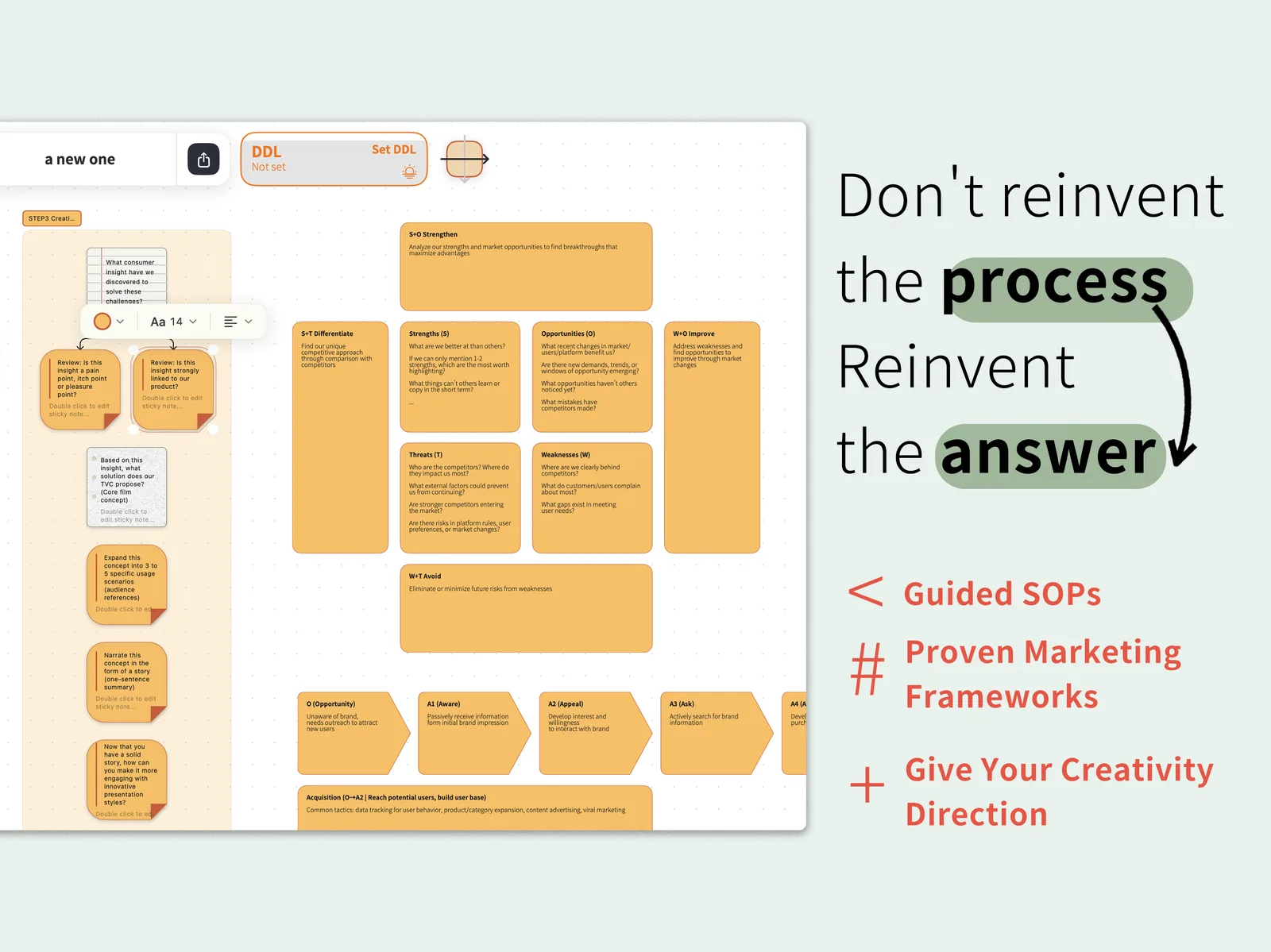
For brand TVC planning, Pufuf has a built-in professional guided SOP that organizes the key questions of brand communication into a planning process you can work through step by step.
Users can follow the SOP’s guidance to work through project background, communication goals, brand strengths, user insight and creative expression.
What it aims to help planners solve isn’t just “how the proposal should be laid out”, but the questions that come before that:
- Facing a new brand project, what should you get clear first?
- How do you distill the value truly worth communicating from brand information?
- How do you turn user insight into a basis for the creative?
- How do you keep the creative concept aligned with the brand goal?
- How do you develop the idea further into a complete TVC story?
By turning professional planning experience into clear guiding questions, Pufuf aims to help users complete their planning work in a more organized way.
For newcomers, it’s a thinking path they can follow; for experienced planners, it’s a professional framework they can reuse, adjust and add to.
Planners still bring their own judgment and ideas. The SOP helps them organize that judgment better and makes the thinking process clearer.
Pufuf is also exploring combining this professional SOP with AI, letting AI help with research, reasoning through ideas and drafting proposals, based on the project background and what the user has worked out.
The professional SOP provides the thinking framework; AI helps improve execution efficiency.
For brand TVC planning, what always matters most is first getting clear on what the brand wants to say, then deciding how to turn it into an ad worth remembering.
09 · Conclusion
Brand advertising and performance advertising aren’t a contest where you have to pick a side.
Performance ads help a business capture demand and drive sales; brand building helps it accumulate awareness, build preference, and create more possibilities for future growth.
When a business stops focusing only on immediate traffic and conversion and starts seriously thinking about why its brand deserves to be chosen, its marketing gains a longer-term perspective.
For advertising professionals, brand building ultimately has to come down to concrete communication content.
From understanding the brand, to gaining insight into consumers, to finding the idea and telling the story well, every step deserves serious attention.
A good brand TVC doesn’t just complete one round of advertising. It helps consumers understand the brand, remember it, and have one more reason to choose it in the future.