
Interview Background
Fancy Films has been one of the most talked-about local creative agencies in China over the past few years.
With sharp creative insight and mature brand co-creation philosophy, the agency has produced a string of viral benchmark works and earned wide recognition in the marketing community.
We launch this in-depth interview to explore the underlying logic of how brands and agencies can collaborate in the true sense.
Interviewer: PUFUF
Interviewee: Founder of Fancy Films
PUFUF:
Today we’re
discussing a core industry topic that everyone talks about, yet few
fully understand.
What exactly does genuine “collaboration”
mean between brands and creative agencies?
The industry default
now is quite simple: brands set the brief, agencies execute and
deliver. Do you agree with this conventional supply-demand mindset?
Fancy Films(Island):
Frankly, I completely disagree. I’d even say this rigid
mindset is the root cause of massive internal friction in our
industry.
Many reduce collaboration to a straightforward
transactional relationship: the brand pays and issues a brief, while
the agency takes the order, delivers proposals, revises endlessly,
and wraps up with final delivery.
To be honest, this is merely
outsourcing execution — it should never be regarded as real brand
collaboration.
PUFUF:
There’s also a
widespread stereotype in the industry: that creative and advertising
professionals are inherently more sophisticated than brand-side
teams when it comes to branding and creativity. What’s your view on
this?
Fancy Films(Island):
I
really want to correct this misunderstanding.
First and
foremost: creative agencies are neither smarter nor superior to
brand clients.
There is no scenario where one side lectures or
dominates the other.
Brand teams have been deeply rooted in their own industry for years,
even decades.
They understand products, sales channels, end
consumers, corporate strategy and business logic — professional
insights no external agency can replace.
Yet brands also have
inherent limitations: being immersed in their own ecosystem, they
are easily confined by internal inertia and fixed thinking.
It’s
difficult for them to step outside established perceptions and
reinterpret their brand essence from an objective third-party
perspective.
As creative agencies, our strengths lie in an outsider’s viewpoint,
cross-industry insights, systematic brand narrative frameworks, and
polished creative expression.
We help brands break internal
constraints and reconnect with the market with a fresh tone.
Still,
we have obvious blind spots and boundaries: we are distant from
frontline business operations, retail channels, and internal
corporate decision-making.
It’s easy for agencies to craft
visually impressive, attention-grabbing concepts that look brilliant
but are detached from real business landing.
To sum up plainly:
Brands have their cognitive blind spots and
limitations; agencies have their own weaknesses and boundaries.
Both
sides hold irreplaceable professional strengths, while each carries
unavoidable cognitive constraints.
True collaboration is never about one side convincing, overriding,
or compromising for the other.
It begins with both sides
standing on equal ground, acknowledging each other’s flaws and
limits, then integrating respective strengths, aligning toward one
unified brand goal, and moving forward side by side.
That is
the true essence of partnership.
PUFUF:
Your portfolio
includes two iconic benchmark projects. Let’s first review their
verified market results, then unpack the like-minded collaboration
logic behind them.
Case Profile · NATURES Project Achievements
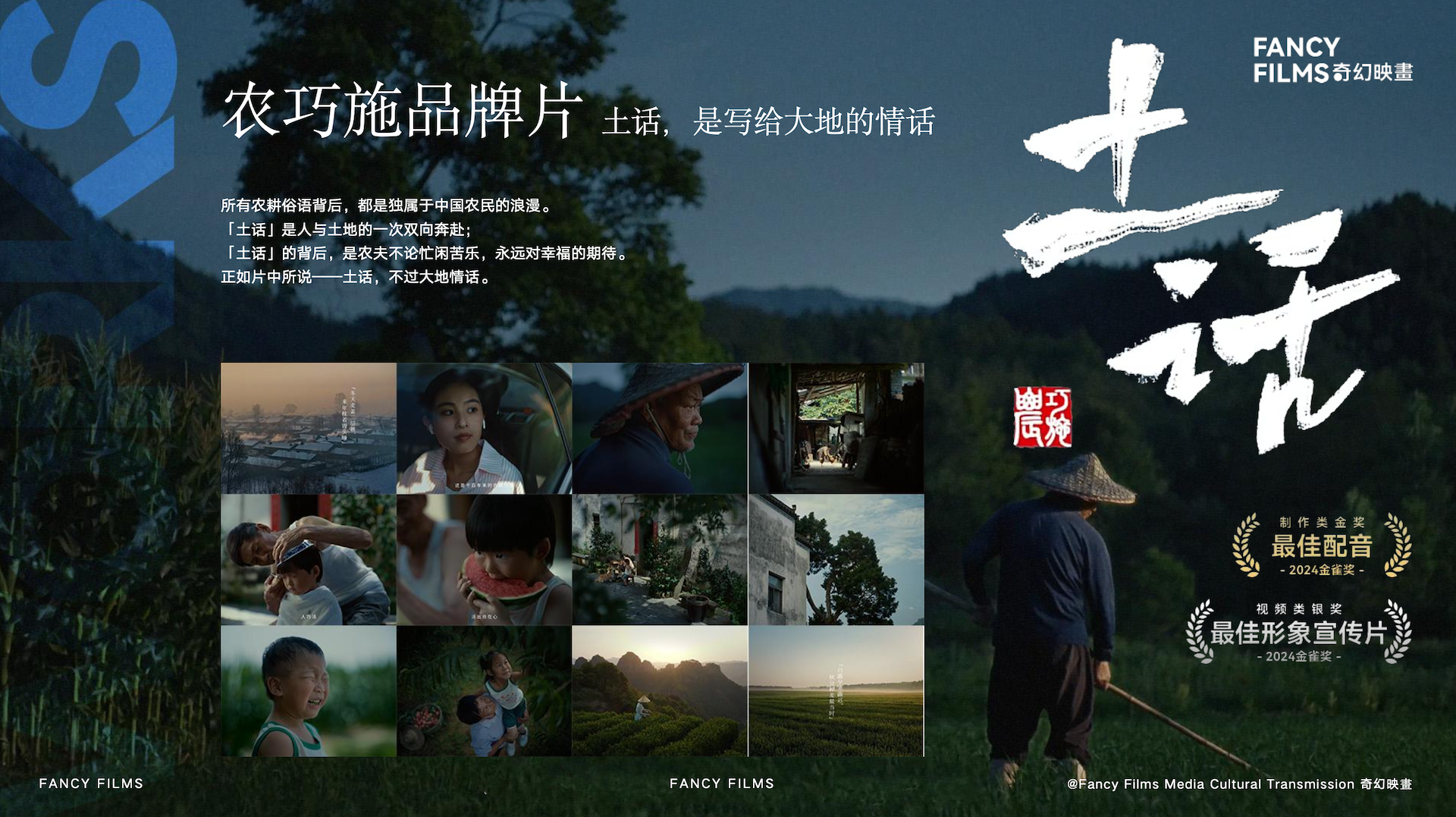
Upon release, the project drew widespread attention across the agricultural materials sector and received interview invitations from major industry media.
Authoritative platforms including China Central Video and Xinhuanet have included the official video production.
On NewFilm, the work achieved over 130,000 organic views, more than 2,000 collections and over 400 reposts.
It ranked No.1 on NewFilm’s corporate image promotional chart for two consecutive weeks, and No.2 on the platform’s overall chart over the same period.
PUFUF:
Let’s start
with NATURES. How did this project perfectly embody the
complementary strengths and mutual achievement you just described?
Fancy Films(Island):
NATURES is a perfect real-life example of the collaboration
logic we’ve been discussing.
From our very first communication, the brand had clear
self-awareness.
They possess profound expertise in agriculture,
with in-depth knowledge of land, crops, and farmers’ actual demands,
fully mastering the underlying logic of the industry — this is their
irreplaceable advantage.
At the same time, they clearly recognized their own limitation:
As
industry insiders deeply immersed in technology and product
parameters, they can easily get trapped in technical terminology and
professional jargon.
They struggle to translate their brand
sentiment and new-generation farmer ethos into accessible,
emotionally resonant public communication.
From the very start, they never viewed us as a rigid execution
vendor bounded by trivial restrictions.
Instead, they granted
us ample creative freedom, abandoning the outdated formula of
product-centric indoctrination.
On our part, we maintained professional humility.
We never
overstepped to interfere with their industry judgment or product
logic.
We simply leveraged our third-party perspective:
streamlining
rigid technical wording, exploring the simple humanistic philosophy
embedded in farming culture,
and reorganizing, elevating and
expressing the brand’s inherent spirit through warm, empathetic
storytelling.
The entire process was never a top-down order-and-execute model, nor
did we impose self-indulgent creativity onto the brand.
The
brand firmly guarded its industry and product fundamentals, while we
took charge of brand toning and creative narrative packaging.
Complementary
strengths, aligned cognition — this is why the collaboration ran
seamlessly and delivered work with genuine depth and texture.

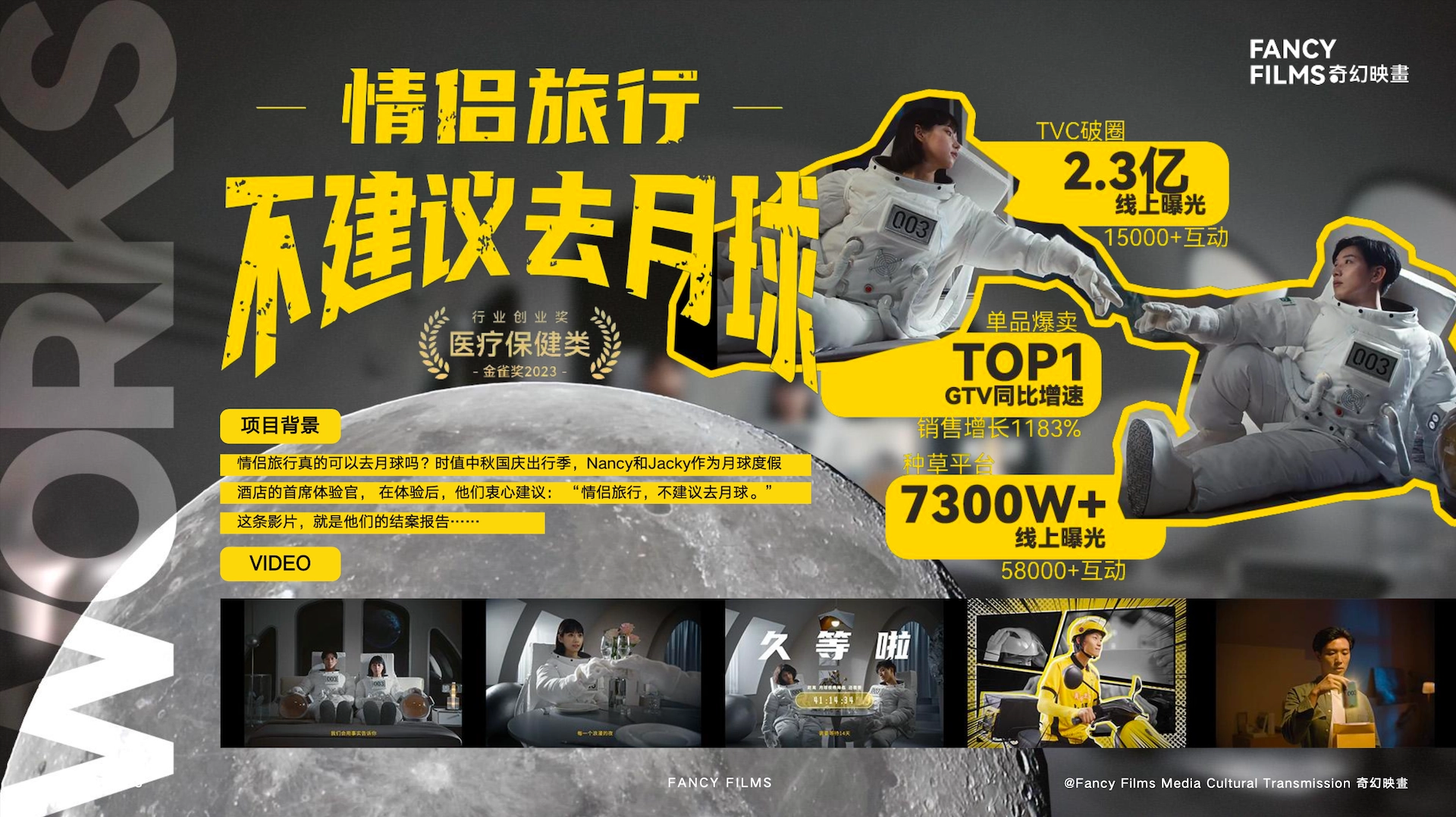
Case Profile · Okamoto × Meituan Food Delivery Co-branded Campaign
The brand video achieved viral success, recording 230 million overall online exposures and over 15,000 interactions.
Across Douyin, WeChat Moments, RED and Bilibili, the campaign accumulated over 73 million exposures and more than 58,000 interactions.
The 3-piece skin care set recorded a 336% year-on-year sales increase.
On October 1st, its Gross Transaction Volume growth ranked No.1 in the category.
Sales in new supply channels rose 1183% year-on-year; the convenience chain Songshu attained a 600% year-on-year growth rate.
On October 5th, Meituan Pharmacy saw an 86.3% year-on-year GTV increase.
The production won the Golden Sparrow Awards (Gold Prize, Healthcare Category) and the Tiger Roar Awards (Bronze Prize, Video Marketing Category).
PUFUF:
These figures
speak volumes. Let’s talk about the Okamoto × Meituan Food Delivery
co-branding project. How did it reflect this equal, complementary
and like-minded collaboration model?
Fancy Films(Island):
This project serves as another classic template for aligned
partnership.
Okamoto has always upheld a clear youthful attitude, brand tonality
and user positioning.
The brand knows precisely how to engage
young audiences with a relaxed, playful and emotionally resonant
personality — core values they always uphold firmly, without being
swayed by external creative proposals.
Even so, they have internal constraints: established brand
frameworks, fixed marketing rhythms, and compliance boundaries.
To
develop unconventional, imaginative and viral co-branding concepts,
they require an external creative agency to drive creative
breakthroughs.
There was a small anecdote in the early negotiation stage.
The
brand initially assumed we specialized in short-video operation,
which is actually not our core strength.
We never exaggerated
our capabilities or accepted the project with empty promises.
Instead,
we candidly clarified our professional scope and boundaries.
It was precisely this sincerity that impressed the brand — our professionalism, sense of propriety, and clear positioning without overhyping or blind catering.
We later delivered the well-received concept Couples Are Not
Recommended to Travel to the Moon.
The collaboration followed
the same complementary logic:
The brand maintained its inherent
tonality, core values and compliance bottom line, granting us
sufficient creative space.
We never violated the brand’s
original temperament or forcibly implanted inconsistent gimmicks.
We
extended its relaxed youthful vibe through imaginative,
counter-intuitive creativity, fully capturing the emotional
atmosphere and resonance of the co-branding campaign.
There was no hierarchical gap, no one-side command.
The brand
anchored its core positioning, while we drove creative
breakthroughs.
Both sides maximized their strengths,
compensated for each other’s weaknesses, and advanced toward the
same goal — resulting in work that was both viral in influence and
effective in business conversion.
PUFUF:
After breaking
down these two cases, the logic becomes very clear. From a creative
agency’s perspective, what is the biggest pain point prevailing in
industry collaboration?
Fancy Films(Island):
Ultimately, it all comes down to mindset and positioning.
Too
many brand-side teams regard agencies merely as execution tools,
focusing only on delivery results while ignoring professional
insights and refusing to offer co-creation space.
On the other hand, many agencies fall into a sense of creative
superiority.
They overvalue their own aesthetic and conceptual
ideas, while overlooking brands’ real business logic and accumulated
industry cognition.
One side treats the other as a tool; the other regards itself as a
mentor.
With such confrontational mindsets from the very
beginning, collaboration inevitably turns into endless bargaining,
guesswork and repeated revisions, draining energy on both sides.
In truth, collaboration does not need to be so complicated.
Genuine
partnership is built first on equal standing.
Acknowledge that
both sides possess professional expertise worthy of respect, as well
as cognitive blind spots needing complementation.
Let go of
hierarchical prejudices, set aside the labels of Party A and Party
B, abandon game-playing and deadlock.
Stick to your own
professional boundaries, give full play to respective strengths, and
work toward one shared brand objective.
Once both sides reach this state, brands and agencies can greatly reduce unnecessary internal friction, and jointly create works with long-term brand value.
PUFUF:
Finally, could
you define the ideal brand-agency partnership in one sentence?
Fancy Films(Island):
No reliance, no domination;
Distinct professional
boundaries, respective core strengths;
Complement cognitive
blind spots, grow alongside each other;
Aligned mindset, shared
destination.
This is what authentic collaboration between
brands and creative agencies should be.